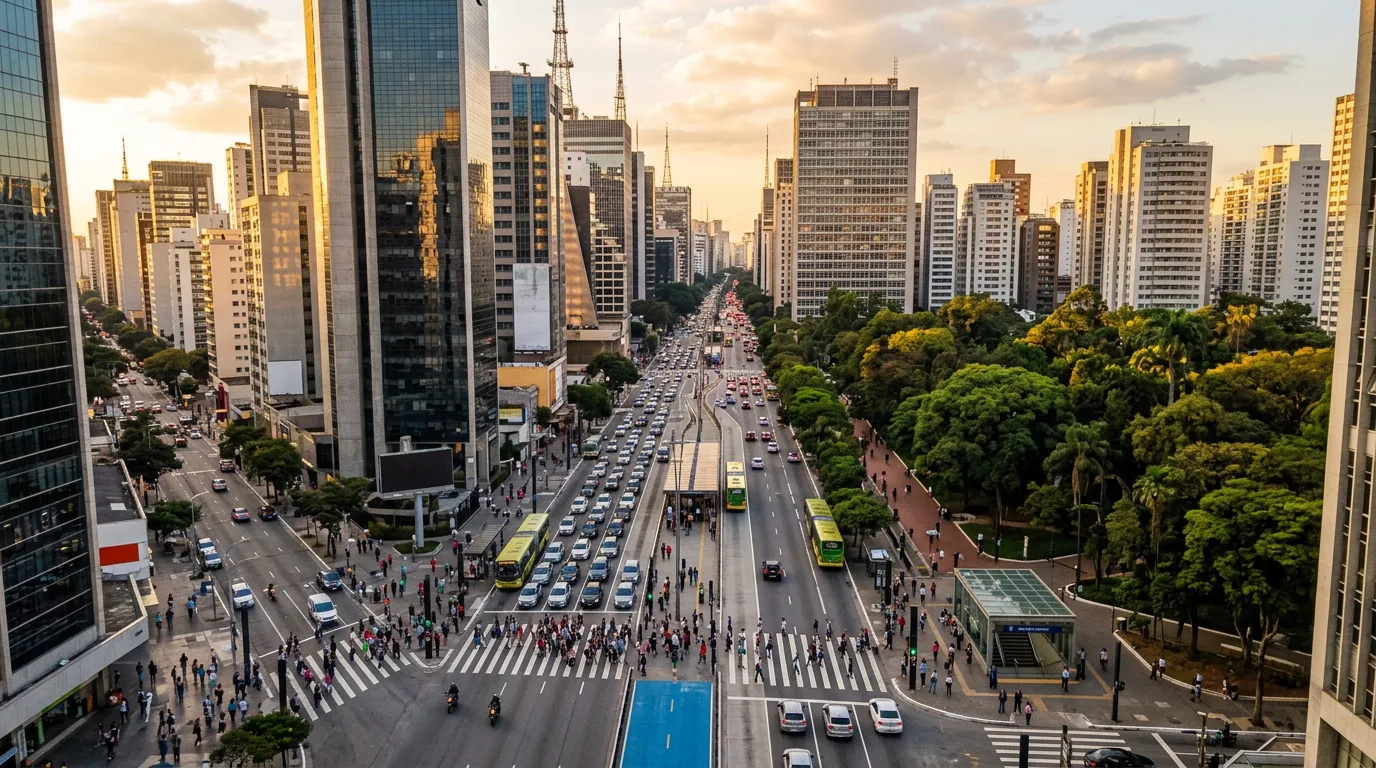
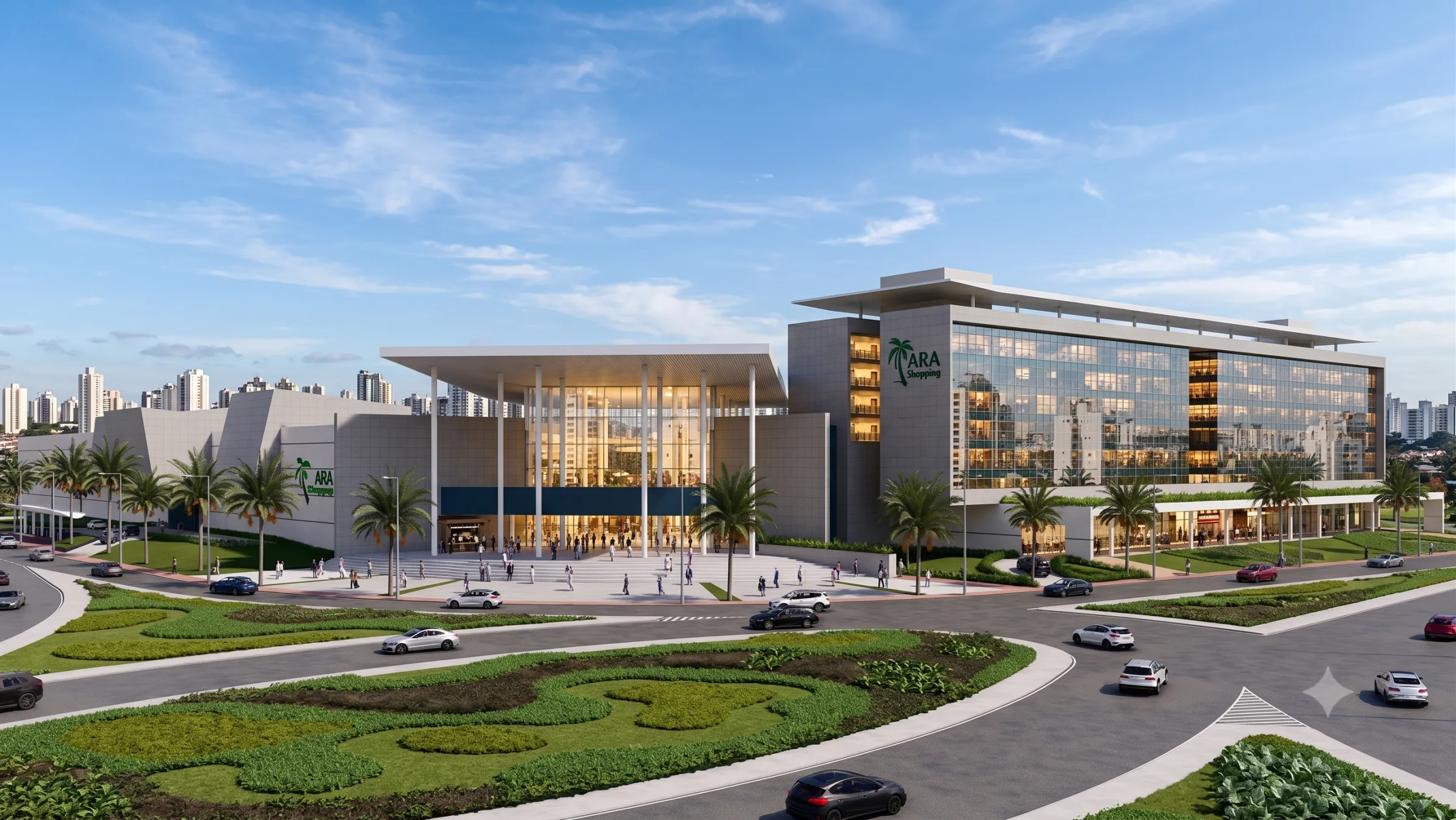
The development does not follow the city, it pulls the city
There is a difference in kind between the building that settles somewhere because movement is already there and the building that creates the movement. The first is a consequence. The second is an anchor. A large-scale development almost always belongs to the second category, for a simple operational reason: it brings compulsory, daily flow. People who study there, work there, are served there or board there do not choose to show up when the economy is good. They show up every working day, at the same hour, for decades.
That flow produces three effects in sequence, and the sequence is what matters to anyone allocating capital. First, it sustains services that could not sustain themselves: the bakery, the pharmacy, the lunch restaurant, the car park, the stationery shop. Second, it justifies public infrastructure that, without concentrated demand, would sit in the queue for decades: the bus line, the resurfacing, the sewage network, the traffic light. Third, the sum of the first two changes expectations about the surroundings, and expectation is what prices land.
The practical consequence is that a large-scale development works as an urban planning decision taken by people who may not have known they were taking it. Choosing the site for a terminal or a campus is choosing where the city will grow over the next twenty years. That decision is usually treated as a question of land availability and expropriation cost, and it is the most structuring one of the whole set.
Brazilian law measured this already, and it did so in 1966
The anchor effect is usually presented as a market reading. It is not only that. It is written into the Constitution and into the National Tax Code, with a name, a perimeter and a calculation method. The 1988 Constitution lists, among the taxes public entities may create, one that exists solely because of this effect.
The National Tax Code, from 1966, is the one that spells it out. And the detail is remarkable, because the legislator had to name precisely what the market names by intuition.
Read the central phrase again: public works from which land value uplift arises. The law does not ask whether the work raises value. It assumes that it does, and moves straight to the next problem, which is measuring how much and where. The following article describes that method.
Points d and e are a small treatise on urbanism written in tax language. They say the benefit has a perimeter, and that inside that perimeter it is not uniform. That is exactly what any market analysis does when it draws radii around an anchor and assigns different weights to each distance band. The table below translates the terms, and the right-hand column is Arsenic's reading, not the law's.
| What the law calls it | What it means | What it decides for capital allocation |
|---|---|---|
| Public works from which land value uplift arises | Legal recognition that a public work creates private value around it | The whole premise. Without it, the anchor is guesswork |
| Delimitation of the benefited zone | The perimeter within which the effect happens | How far out it is worth buying, and where the effect stops reaching |
| Absorption factor of the value uplift benefit | Recognition that the effect varies by area inside the same perimeter | That the curve is not flat. Frontage at the access is not worth the same as the back of the plot |
| Increase in value that the work produces for each benefited property | The individual gain attributable to the work | The calculation that separates anchor uplift from general city-wide uplift |
| Overall ceiling of the expenditure incurred | Government cannot recover more than it spent on the work | There is a cap on public capture. The surplus stays with whoever holds the land |
The Tax Code deals with public works, and one could object that a private development is a different matter. The Estatuto da Cidade answers that directly, when it defines who must produce a prior neighbourhood impact study.
The phrase that matters is private or public. And among the seven questions that study must analyse, in art. 37, is land value uplift. In other words: when the anchor is private, the law does not tax the value it creates around it, but it requires that value to be measured and made public. Same mechanism, different question of who keeps it.
One element is still missing, and it comes from the Estatuto da Cidade. Among the general guidelines of urban policy there is one that states the problem plainly.
And the same statute places land value uplift among the seven minimum questions the prior neighbourhood impact study must analyse, in item IV of art. 37. Putting the three rules together leads to a conclusion that changes the tone of the conversation: the value created by a large-scale work is recognised, measurable and legally contestable. It is not an invisible bonus. It has a contested owner, and the contest is an old one.
The anchor does not follow the city.
It decides where the city goes.
Five conditions that separate an anchor from a big building
Not every large-scale development anchors anything. Built area is not the criterion. What decides it is whether the project meets five conditions at once. Fail one and the effect shrinks. Fail two and it disappears.
- Daily flow, not seasonal. A development used four times a year moves the local economy four times a year. A campus, a terminal or an administrative headquarters move it on two hundred and some days. It is frequency, not the peak, that sustains retail around it.
- Access resolved before opening day. The anchor effect depends on people getting there. A facility delivered before the road, the public transport and the footway that connects it to the existing fabric spends years operating below what it could, and the surroundings respond to that performance, not to the design.
- Scale matched to the city receiving it. A facility sized above real demand becomes an operating cost the budget cannot carry, and an undersized development never reaches critical mass. In both cases the anchor does not hold.
- A ground floor and a perimeter that give something back to the street. A development walled on every side concentrates flow and distributes nothing. The retail that should appear across the street does not appear, because there is no footway with a reason to be on it.
- Operation contracted, not merely planned. A finished building with no staff, no operating budget and no maintenance contract is an anchor that does not anchor. The surrounding market reads the operation, not the construction.
In a coastal city, the anchor solves a different problem
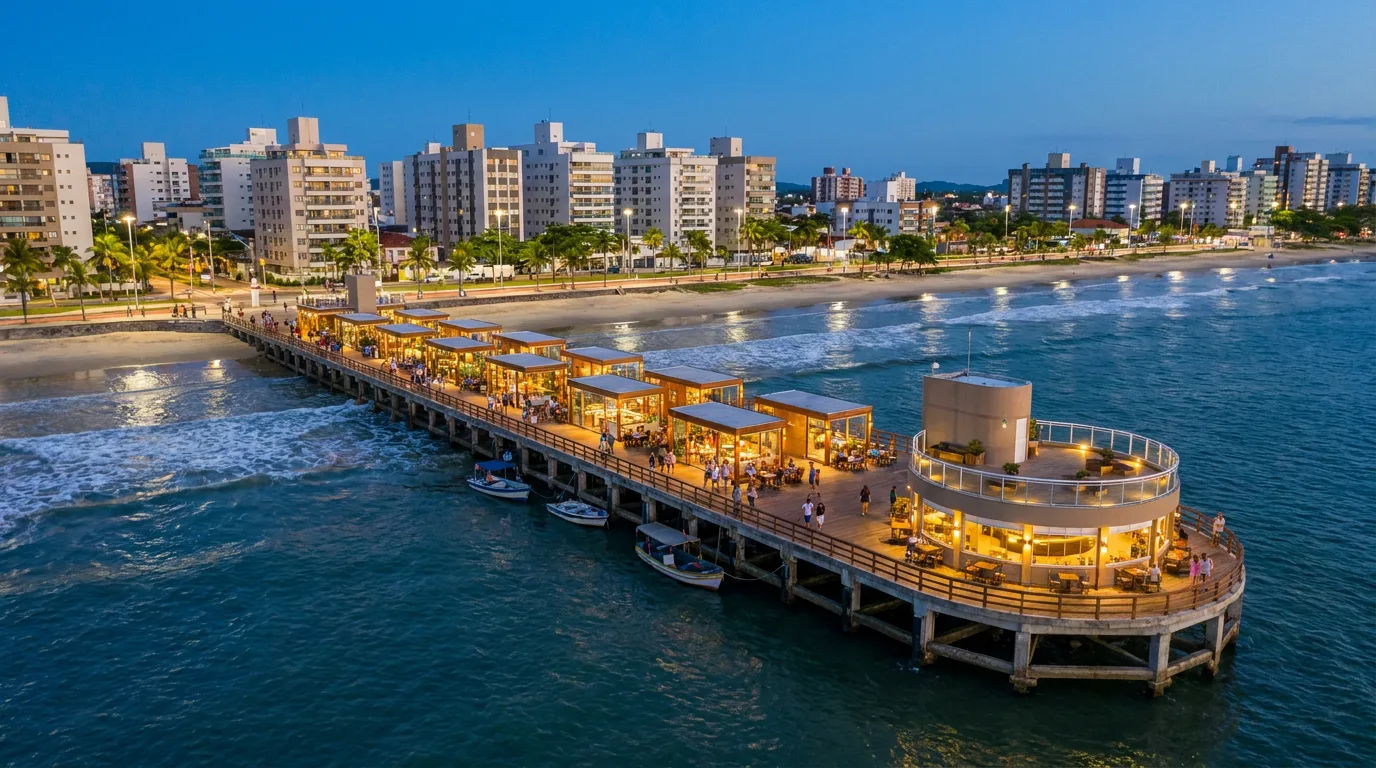
The logic of the anchor becomes clearer, and more decisive, in a beach town. The geometry is different: it grows along a line, the seafront, and the inland core sits behind that line, with less value and less infrastructure. And the flow is seasonal by nature. Two full months, ten empty ones. Retail hires for the peak, lives off the peak and crosses the rest of the year below break-even.
In that context, the first of the five conditions above stops being a bullet point and becomes the entire problem. A coastal anchor is only an anchor if it gives a reason to use the city out of season. A large-scale development placed on the waterfront can do three things no other programme does at the same scale: extend the useful hours of the seafront into the evening and the shoulder season, create a destination for the resident and not only for the holidaymaker, and stitch the inland core to the water through a transverse axis, in a city that almost always has only an axis parallel to the beach.
The opposite is equally possible, and more common: privatising the view, interrupting access to the sand and concentrating cars on the single parallel road the city has. The difference lies in the programme and in the site strategy. And there is one factor that does not exist inland: on the coast, the land at stake is rarely the owner's alone.
The consequence is structural, not aesthetic. A waterfront project touches federal property, its own environmental licensing and, frequently, a use authorisation, which lengthens the timeline and changes who sits at the table. The Estatuto da Cidade adds a requirement that often goes unnoticed: a master plan is mandatory for any city within an area of special tourist interest, under art. 41, item IV. In other words, the coastal municipality that attracts this kind of investment is precisely the one federal law obliges to have a plan, and it is in the plan that the surroundings of the anchor are decided.
For anyone structuring a deal, that is an advantage before it is an obstacle. A longer timeline and a higher barrier to entry mean less competition over the scarcest asset these cities hold, which is the waterfront. Whoever arrives later competes for the inland core.
The anchor that pulls nothing
The failure pattern is familiar and repeats with a regularity that should no longer surprise anyone. A large development is placed on cheap, distant land, chosen because it was available rather than because it structured anything. It is delivered before the access. It stays fenced. The operation is approved on a tight budget and cut the following year. Five years later the surroundings look the same, and the conclusion left standing is that the development brought no development.
That conclusion is wrong on one decisive point. It did not fail to anchor because it was large, or public, or private. It failed to anchor because the conditions that produce the effect were not treated as part of the project. They were treated as somebody else's department, somebody else's budget, sometimes somebody else's administration.
The reverse is worth recording, because it is rarer and more instructive. When access, operation and the design of the surroundings enter the same account from the initial study onwards, the same building, on the same site, at the same cost, produces a different result. The difference is not in the building. It is in what was decided around it.
A development creates a point. The masterplan creates the vector
On its own, a development produces a point of attraction and a diffuse uplift that spreads at random: whoever happened to own land nearby gains. It is real value, but it is value captured by nobody who planned for it.
What turns that point into a growth vector is the plan for the surroundings, and it has specific components: the subdivision that sets blocks and plots at the right scale, the road system that connects the anchor to what already exists, the distribution of uses that lets services and housing appear where the flow passes, the density the master plan allows in each band, and the phasing, which says what gets built at each stage and on which trigger. Without that, the value still appears, but it appears scattered and it arrives late.
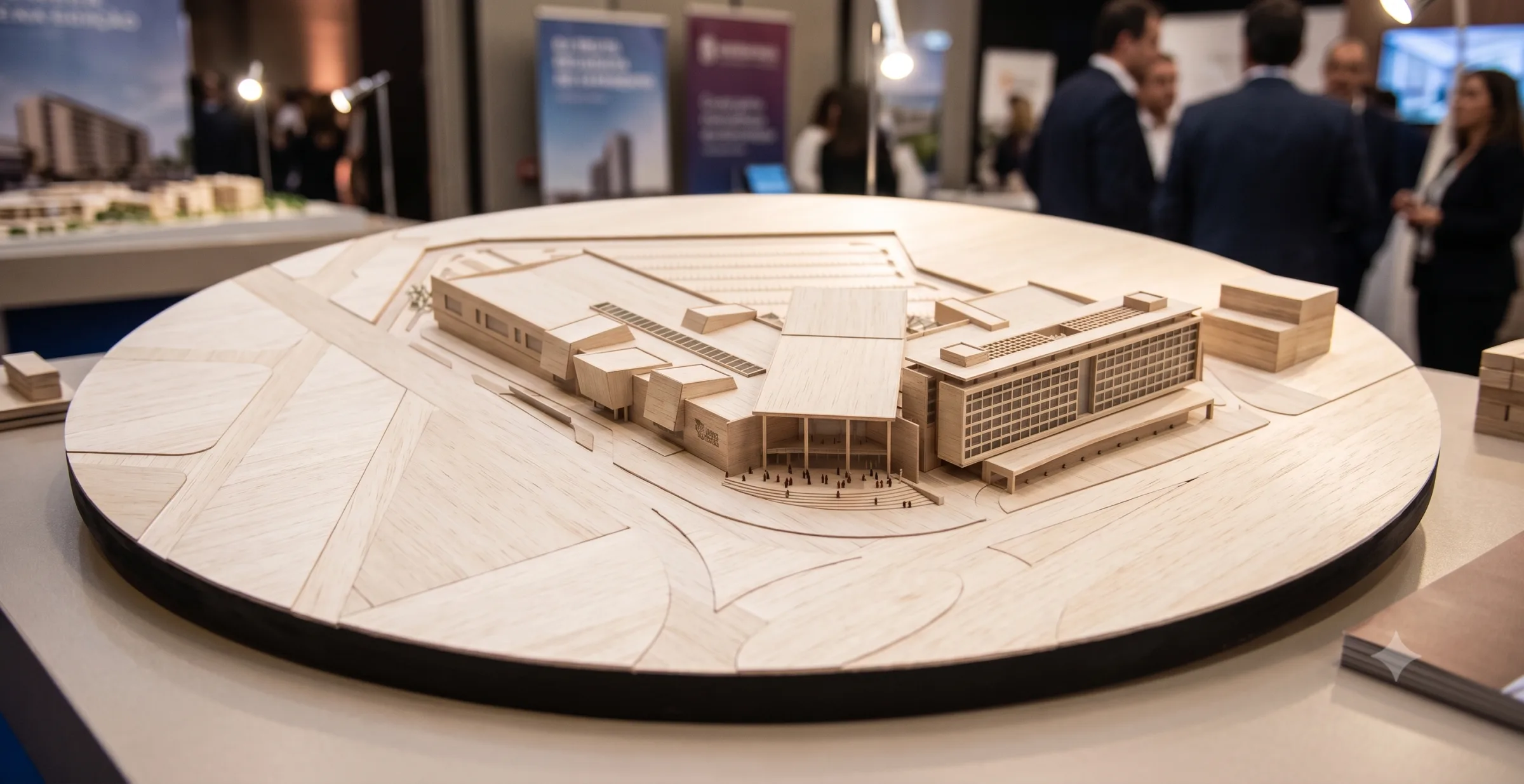
This is why serious large-scale work begins as a feasibility study and not as an architectural project. The design of the building answers a question about programme. The study answers three earlier and more expensive questions: whether the development stands up, who pays for it, and what it does to the territory around it. Whoever commissions the second stage without having done the first buys a building. Whoever does both in the right order buys a position.
Six questions before allocating capital around an anchor
Reading an anchor is done before it exists, and the questions are few. They separate the real opportunity from the statement of intent, which in public works is abundant.
- Does the anchor have committed funding, or an announcement? Approved design, issued licence, published tender and signed contract are different stages, and the distance between them is measured in years.
- Who will operate it, and funded how? Construction has one source, operation has another. An anchor without secured operation does not change its surroundings for long.
- Is the access on the same schedule? Road, public transport and footway delivered with the building, or after it. If after, the uplift arrives after as well.
- What does the master plan allow around it? Coefficient, use and subdivision determine whether the created value can become product there. Land that gains value with no parameter allowing construction is value locked in place.
- Which capture instrument is active in that municipality? Outorga onerosa, operação urbana consorciada, CEPAC and the betterment levy change how much of the gain stays with government. That is not an obstacle, it is a variable in the calculation, and it has to enter early.
- Is a neighbourhood impact study required? Where municipal law requires it, it is both a timeline and a public document. Whoever discovers that after buying the land pays for the discovery.
The thesis closes where it began. A large-scale development is the most structuring piece a city receives, and the one usually decided with the least territorial analysis. Seen from outside, that is at once a risk and an information asymmetry, because most of the value is settled in decisions taken before any announcement. A growth vector is not announced. It is anchored, connected and operated.

Sources consulted
All URLs verified on 8 August 2026.
- Constituição Federal of 1988, official text, Planalto. Art. 20, items IV and VII, and art. 145, item III.
- Lei 5.172 of 1966, Código Tributário Nacional, consolidated text, Planalto. Arts. 81 and 82.
- Lei 10.257 of 2001, Estatuto da Cidade, official text, Planalto. Arts. 2, item IX, 36, 37, item IV, and 41, item IV.
- Estatuto da Cidade in the Arsenic law library, full text with amendment history.
Updated on 8 August 2026. The statutory quotations reproduced here are functional translations of the official Portuguese text and carry no legal force; the original prevails. The quotation from art. 20 of the Constitution is partial, with items V and VI omitted and marked by an ellipsis. The table translating legal terms into capital allocation decisions is Arsenic Arquitetos' technical reading and does not appear in the rules cited, which only fix the concepts. The betterment levy depends on a law passed by the entity that creates it, and its actual enforcement must be checked municipality by municipality. The legal regime of the coastline involves powers and licences that vary by municipality and by the situation of each property, and requires case by case analysis. This article describes the Brazilian federal regime and does not replace consulting the legislation of the municipality where the development is located.