
Place as the concrete manifestation of dwelling
There is a book that few Brazilian architects have opened with patience, but that every serious architect carries in mind when climbing the serra. In Genius Loci, Towards a Phenomenology of Architecture, published by Rizzoli in 1980, the Norwegian theorist Christian Norberg-Schulz argues that place is the concrete manifestation of dwelling, and that the task of the project is to give form to that character.
The landscape of the Serra do Rio is not scenery.
It is a system.
The landscape is not scenery, it is a system
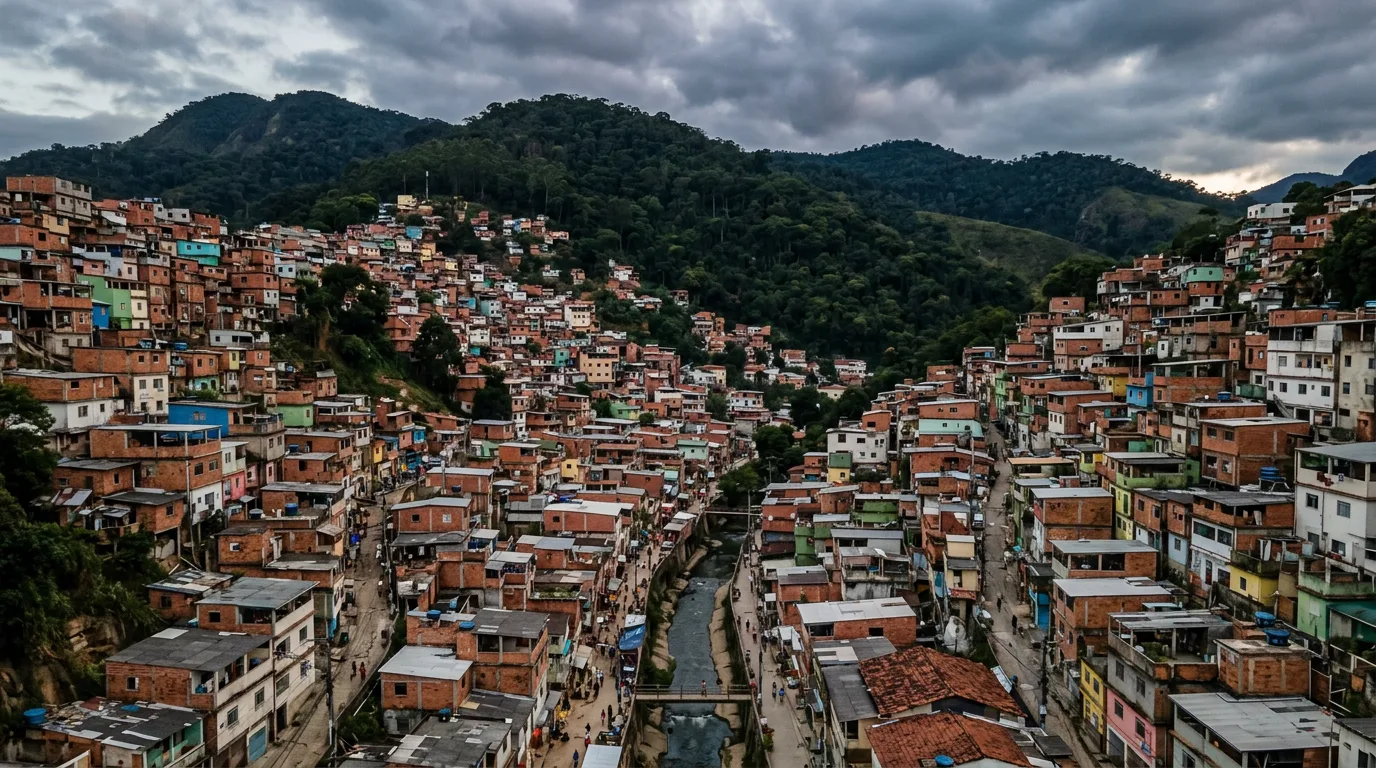
The municipality of Petrópolis has 791.144 km² of territorial area and 278,881 inhabitants counted in the 2022 Demographic Census by IBGE (the Brazilian Institute of Geography and Statistics). The territory is divided into five administrative districts: the seat, Cascatinha, Itaipava, Pedro do Rio and Posse. Rivers that descend fast. Steep slopes. Atlantic Forest that has held the hillsides for centuries, and gives way when topography is misread.
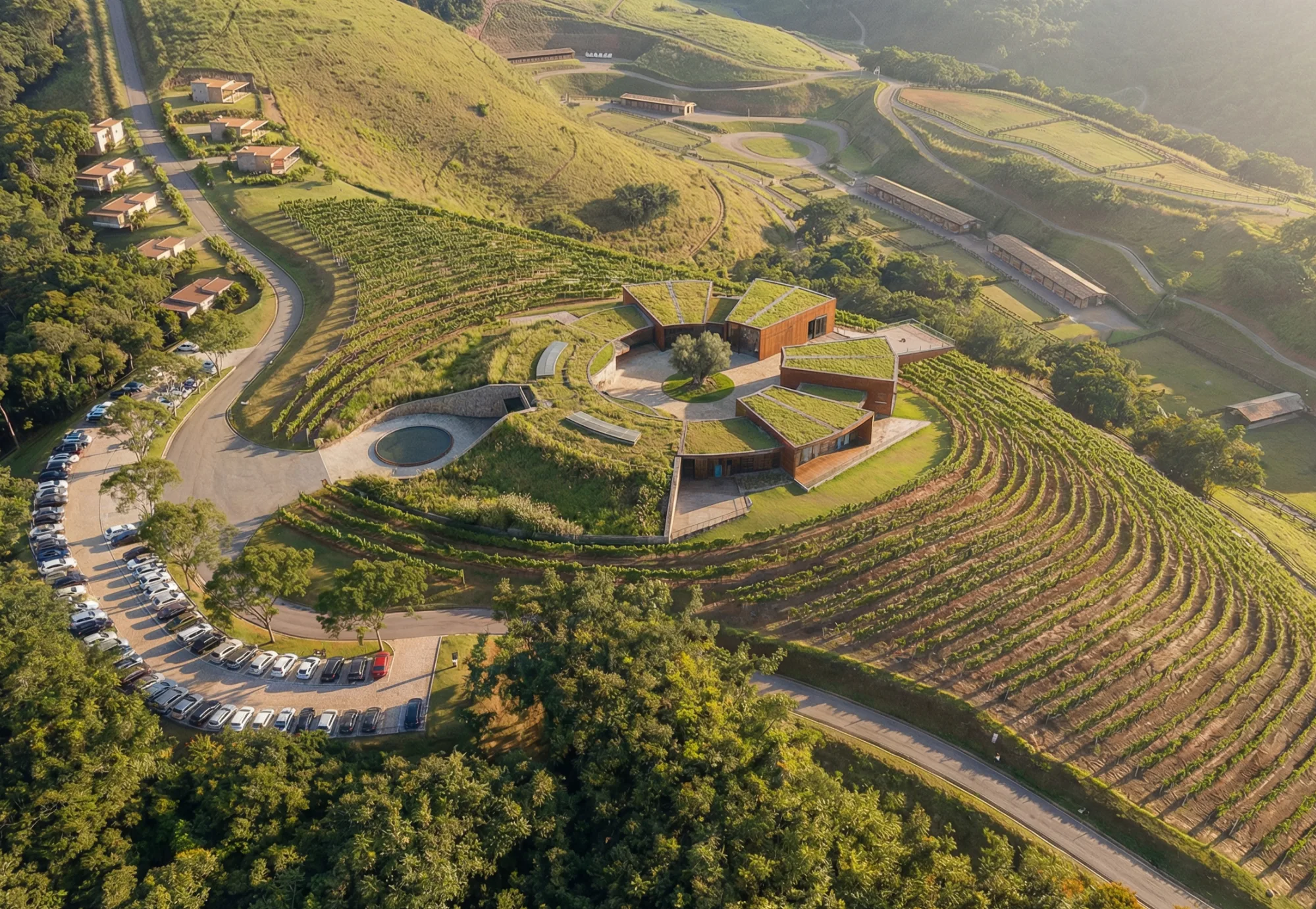
There is a silent difference between building on the serra and building with the serra.
The first poses.
The second listens.
When the soil is bare, the rain finds its way
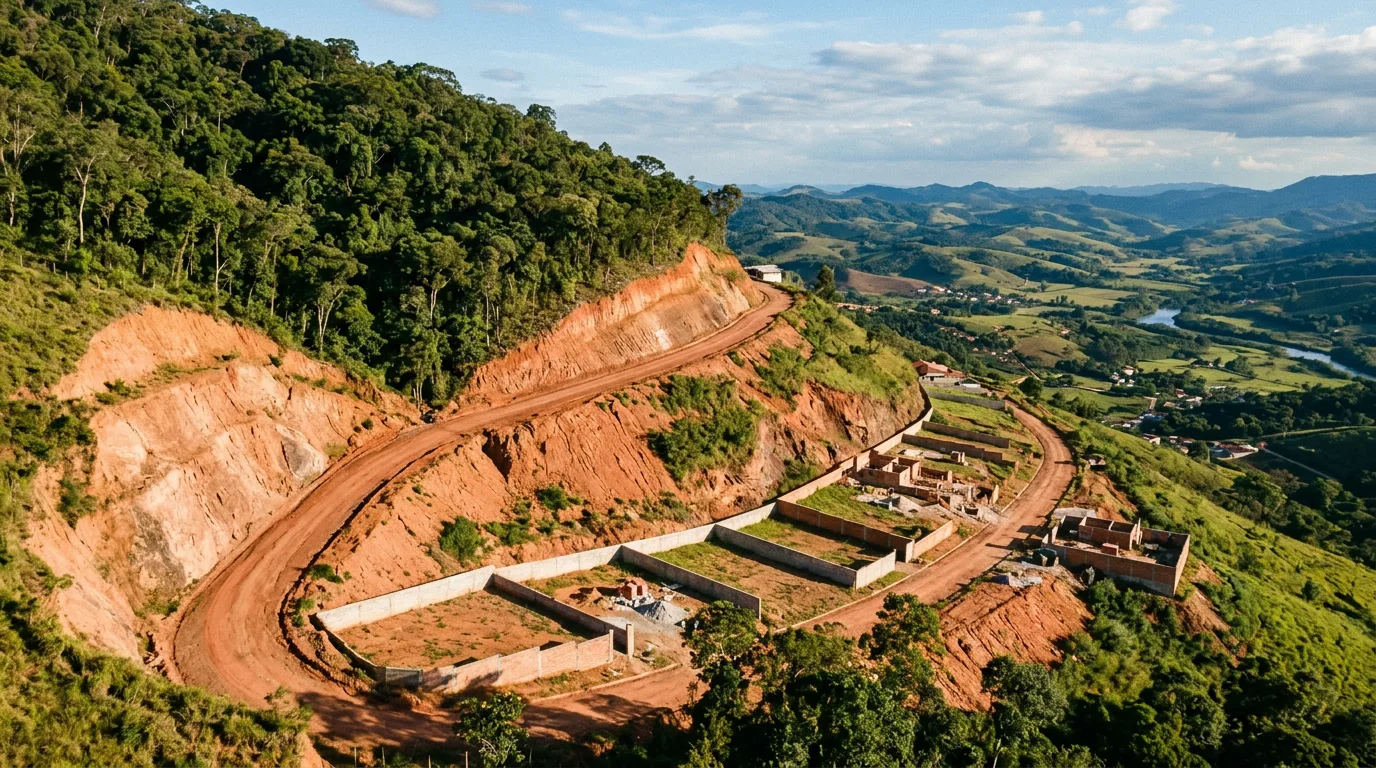
When the soil is steep, water has its way. When vegetation covers it, the rain infiltrates and takes time to reach below. When the mid-slope is cut to open a lot, water finds a new path, faster and shallower. Bare soil becomes mud. The mud becomes tragedy.
On the night of January 11 to 12, 2011, the Região Serrana of Rio de Janeiro was struck by extreme rainfall. The tally by the Rio de Janeiro State Secretariat of Health and Civil Defense recorded about 71 deaths in Petrópolis, concentrated in the Vale do Cuiabá, in the Itaipava district, within an estimated total of between 905 and 918 victims across the entire Região Serrana, with Nova Friburgo and Teresópolis as the hardest-hit municipalities. On February 15, 2022, extreme rainfall concentrated in a few hours struck Petrópolis again. The figures released by the Civil Police through Agência Brasil on March 4, 2022 confirmed 233 victims identified in that episode.
It was not an accident.
It was a diagnosis.
The landscape had given warning.
Genius loci as discipline
Genius loci, in Latin, is the spirit of place. The intangible essence of a site, that which defines its way of existing before any project lands on it. In architecture, it is the discipline of designing without erasing.
In urbanism, genius loci is more than sensitivity.
It is method.
It is the technical reading that precedes the commercial reading. It is understanding that the flat plateau that looks like an excellent lot was once a floodplain, that the embankment with a privileged view sits above a failure plane, that the tame stream at the back of the property has a riparian buffer defined in article 4 of Law 12.651/2012 (Forest Code) that the law does not negotiate. It is recognizing, in section V of that same article, that every slope with a gradient greater than 45 degrees is already a Permanent Preservation Area in its entirety.
After 2011, the Brazilian Geological Service (formerly CPRM, now SGB) and INEA (Rio de Janeiro State Environmental Institute) produced geotechnical cartography for the municipalities of the Região Serrana that had been affected. The City Statute, in section VI of article 41, added by Law 12.608 of 2012, made the Master Plan mandatory for municipalities listed in the national registry of areas susceptible to landslides, flash floods or related geological processes. The maps exist. The legal regime exists. The technical knowledge is available.
What is often missing is the willingness to look before drawing.
Genius loci, in urbanism, is more than sensitivity. It is method.
Serrano districts as silent candidates
This is the point where architecture meets urbanism. Where the individual gesture of a house has to converse with the collective gesture of a city. Where designing stops being an isolated act and becomes policy.
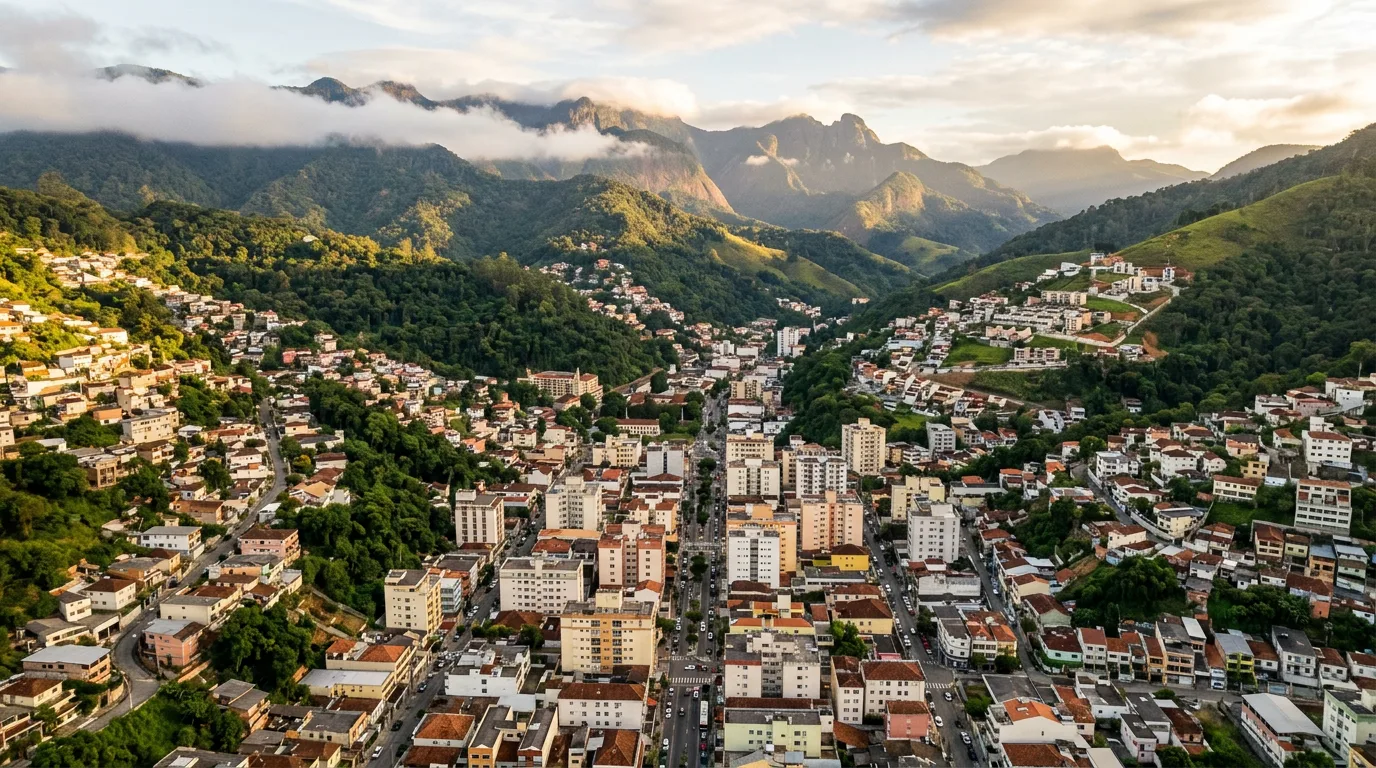
The serrano districts with built identity, stable tourist flow and relevant heritage are silent candidates to become a model.
They have human scale. They have identity. They have heritage. They have tourist flow that sustains the economy. They have populations large enough to justify sophisticated urban instruments such as environmental zoning, OUC (Consorted Urban Operation) and EIV (Neighborhood Impact Study).
What is missing is the reading. What is missing is the active plan. What is missing is the courage to hold the public debate.
Every Arsenic project begins with the same question:
What does this place want to be?
It is not poetry.
It is the work.
Sources consulted
Accessed on May 16, 2026.
- NORBERG-SCHULZ, Christian. Genius Loci: Towards a Phenomenology of Architecture. New York: Rizzoli, 1980. Editorial reference verified in the author's bibliography published on English Wikipedia.
- IBGE, Cidades, profile of the municipality of Petrópolis (RJ). Territorial area 791.144 km² (2025) and population 278,881 (2022 Demographic Census).
- Agência Brasil, March 4, 2022. Civil Police of Rio de Janeiro tally of the February 15, 2022 rainfall in Petrópolis: 233 victims identified.
- Brazilian Geological Service (SGB, formerly CPRM). Geotechnical cartography produced for the Região Serrana of Rio de Janeiro after the January 2011 event.
- Law 12.651, of May 25, 2012. Forest Code, article 4, section V (slope greater than 45 degrees classified as APP).
- Law 10.257, of July 10, 2001. City Statute, article 41, section VI, as worded by Law 12.608 of 2012.