
CEPAC's less famous sibling
The previous article closed with the line that CEPAC is the most financial form of Brazilian urban planning. That instrument takes the headlines and the prospectuses, but it serves a minority of operations in a minority of cities. What sustains the daily life of Brazilian urban policy, from São Paulo to Petrópolis, is a much older, much simpler, and much more neglected instrument: the onerous concession of the right to build. This text explains how it works, why it is the most democratic instrument of the City Statute, and why so many Brazilian cities charge zero for it.
What arts. 28 to 31 say, word by word
The legal provision for the onerous concession of the right to build is in four consecutive articles of the City Statute. The set is short and enough to understand the instrument.
The four articles answer three distinct questions. Art. 28 answers who can charge and in which areas: the master plan enables collection in specific zones, with counterpart. Art. 30 answers how to charge: a specific municipal law defines the formula, exemptions, and the counterpart the beneficiary must deliver. Art. 31 answers where the money goes: the funds are linked to the eight urban purposes listed in art. 26 of the same law. If any of the three is missing, the instrument sleeps.
Three points in the chain, not four
The engineering of the onerous concession is leaner than that of CEPAC. It does not involve CVM, it does not involve a stock exchange, it does not involve a secondary market. It involves three agents only. The master plan defines the enabling. The specific law defines the ruler. The city hall charges at project approval.
The master plan enables.
The specific law calibrates.
The city hall charges.
The simplicity of the gear is one of the strengths of the onerous concession and also one of its weaknesses. Since there is no external regulator, no prospectus submitted to the CVM, no public auction, the instrument depends entirely on the internal consistency of three municipal decisions. If one of them fails, all the rest fails along with it.
How the coefficient becomes counterpart
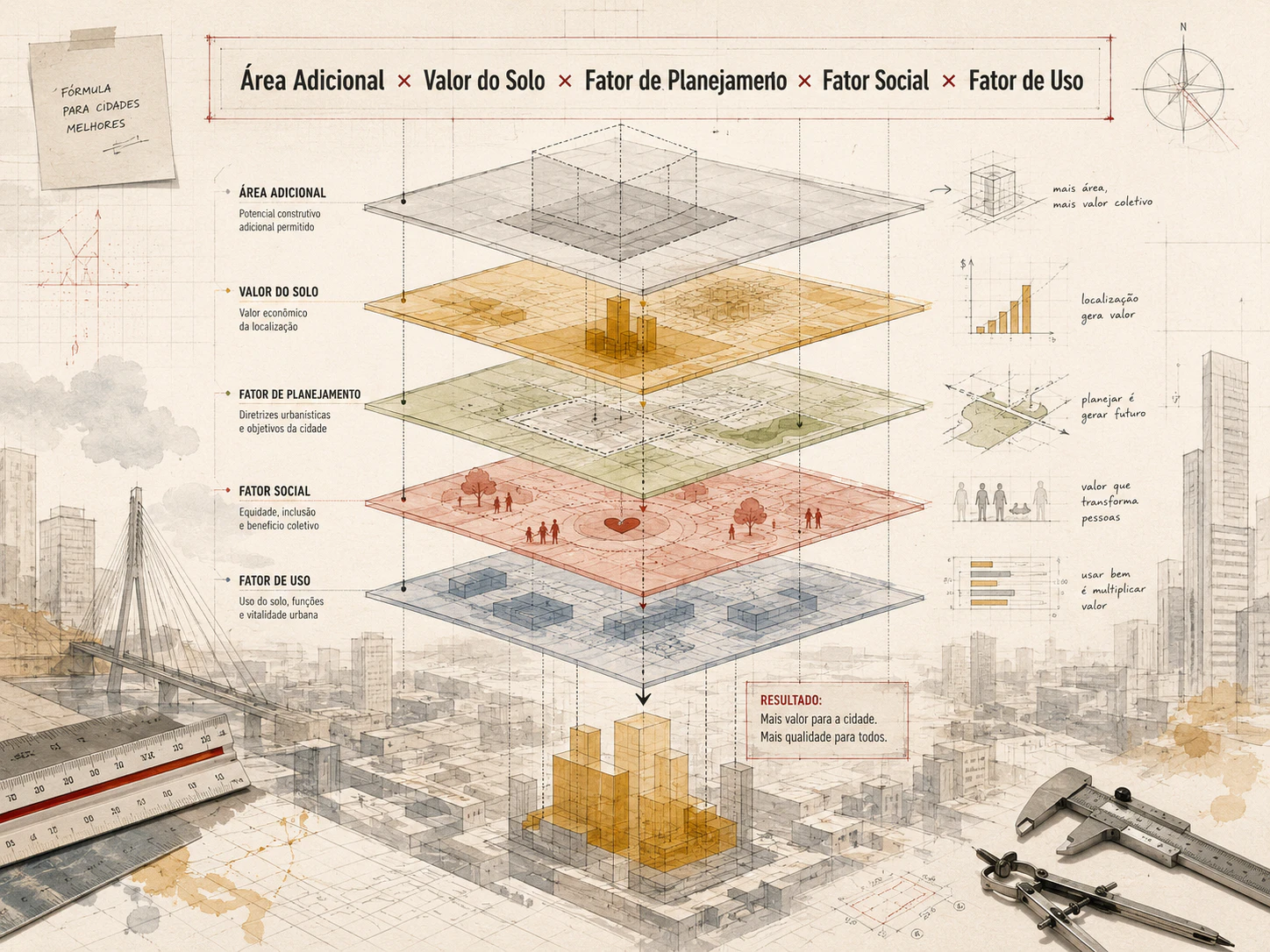
The counterpart calculation formula is the technical heart of the concession. It translates, into currency, the difference between what the master plan allows to build for free and what the development actually intends to build. The formula varies from city to city, but generally combines five variables:
- Additional construction area. The square meters exceeding the basic use coefficient, up to the maximum limit of the zone.
- Unit value of the land. Cost of the square meter of land in the locality, normally derived from the generic value plan of the IPTU or from independent appraisal.
- Planning factor. Coefficient reflecting the public interest in densifying or discouraging the area, adjusted by the current urban policy.
- Social interest factor. Reducer applied when the development delivers counterpart in social-interest housing, public facilities, or green areas.
- Use factor. Coefficient differentiated for residential, commercial, mixed, or service use, according to the master plan priority.
The result of multiplying those variables is the value of the onerous concession owed by the development. The choice of factors is a political decision of the municipality. Calibrating the formula to collect enough without making the development unfeasible is the most delicate work of Brazilian urban policy, and what separates well-done OODC from decorative OODC.
Where the funds go, under art. 31
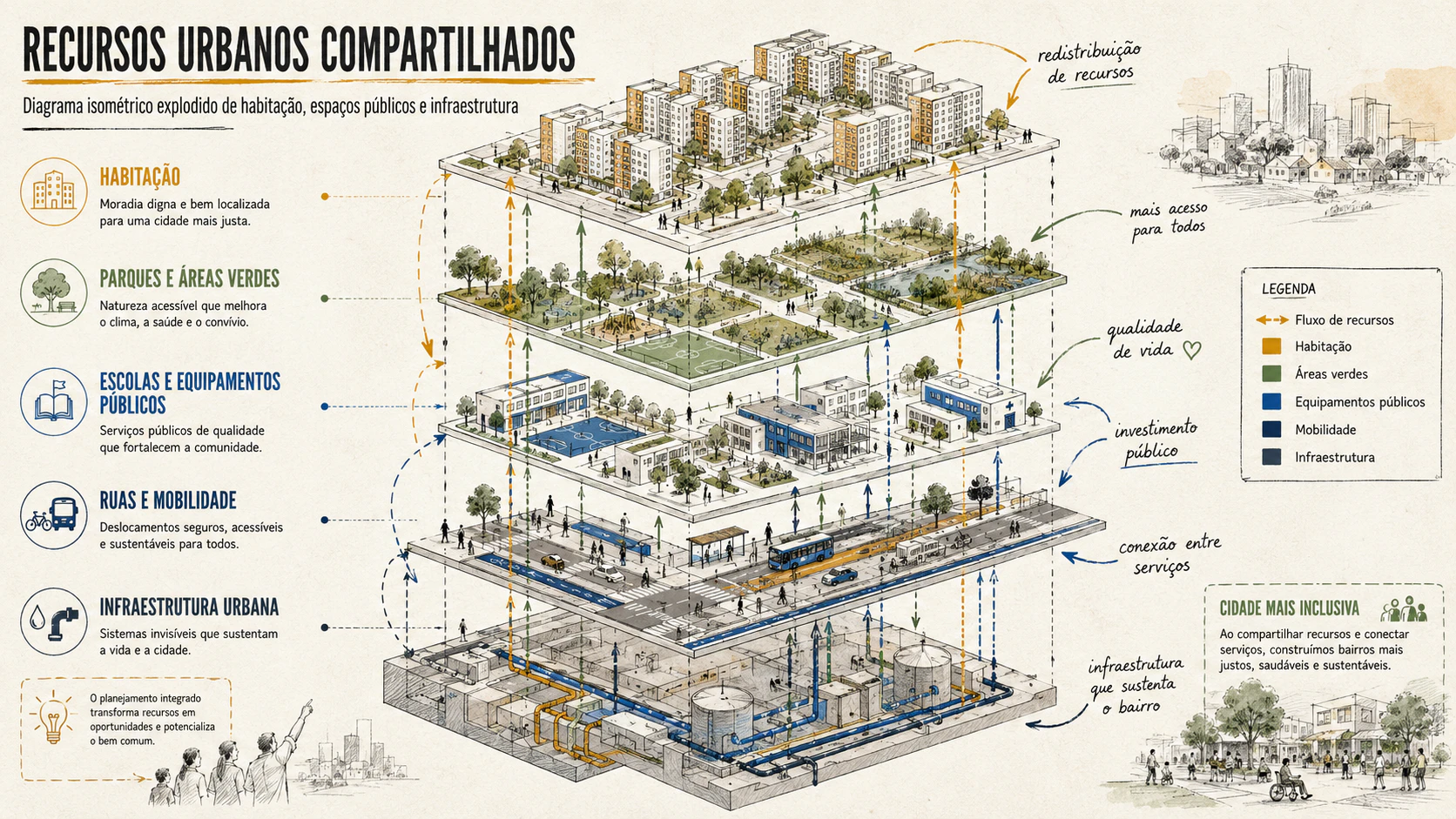
Art. 31 of the Statute mandatorily ties the funds raised to the purposes of art. 26 of the same law. There are eight current purposes:
- Land regularization of urban areas occupied informally.
- Housing programs and projects of social interest, with priority for low-income population.
- Constitution of land reserve for future urban actions.
- Ordering and direction of urban expansion, preventing disorderly growth.
- Deployment of urban and community facilities: schools, health posts, daycare centers, police posts.
- Creation of public leisure spaces and green areas.
- Creation of conservation units or protection of areas of environmental interest.
- Protection of areas of historical, cultural, or landscape interest.
The practical operation of this binding varies. Some cities create dedicated municipal urban development funds, such as São Paulo's FUNDURB, instituted by the Strategic Master Plan of 2014, with its own management council and annual accountability. Other cities simply record the allocation in the current budget and risk losing traceability. The difference between a city that charges concessions and has an active FUNDURB and a city that charges concessions without a dedicated fund is usually visible in the quality of public space ten years later.
OODC and CEPAC, same principle, two scales
The two instruments belong to the same conceptual family: both are ways for the municipality to capture part of the additional value that it itself creates by allowing construction beyond the basic parameter. But they operate on different scales and with very different governances. The table below places the two side by side.
| Axis | Onerous concession, OODC | CEPAC |
|---|---|---|
| Legal basis | Arts. 28 to 31 of the Statute | Arts. 32 to 34 of the Statute and OUC municipal law |
| Where it applies | In any zone provided by the master plan with a coefficient above the basic one | Only within the perimeter of an OUC instituted by specific law |
| Who regulates | Municipality, through master plan and specific municipal law | Municipality issues, CVM registers and supervises |
| How it is paid | Directly to the municipality, at the time of project approval | With certificates acquired in the primary or secondary market |
| Tradability | No title, no secondary market | Book-entry title, freely traded, active secondary market |
| Allocation | Purposes of art. 26, often operated via municipal FUNDURB | Exclusively to the operation itself, under art. 33, § 1 |
| Usual scale | Development by development, mid-sized funding, billion-level totals in major cities | Large-scale operation, hundreds of millions to billions concentrated in one perimeter |
| Who uses it | Any Brazilian city with a master plan | Practically only São Paulo and Rio de Janeiro |
Why so many cities charge zero
The provision of the onerous concession in master plans is practically universal in Brazil. Effective collection, on a scale compatible with the authorized densification, is the exception. Three failures, generally combined, explain the mismatch.
- Regulatory failure. The master plan provides for the concession in the abstract, but the municipality never approves the specific law of art. 30. Without a formula, without exemption cases, without definition of counterpart, the urban planning provision exists and the collection does not. It is the most common form of zero concession. It happens in mid-sized cities and in part of the capitals.
- Formula producing irrelevant value. The municipality approves the specific law, but the formula is calibrated with factors so reduced that the charged value falls below the administrative cost of the collection itself. Typical cases: unit land value derived from an outdated generic value plan, planning factor reduced by sectoral pressure, cumulative reducers that bring the counterpart to zero in practice.
- Allocation without traceability. The municipality charges, collects, but does not create a dedicated fund or management council. The funds enter the budget and mix with current revenues. The binding of art. 31 survives on the accounting balance, but disappears in execution: the funds do not reach the eight purposes of art. 26 at the expected scale. This is the least visible case, and the one that most corrodes the legitimacy of the instrument over time.
The most democratic instrument
Onerous concession of the right to build does not need a prospectus, does not need the CVM, does not need a stock exchange, does not need a consortial operation. It needs three well-made municipal decisions: an honest master plan, a calibrated specific law, and a city hall willing to charge. That is why it is the most democratic instrument of the City Statute. Every Brazilian city with a master plan can use it.
That is also why it is the most neglected. Where the onerous concession works, it funds the public space that the current budget cannot reach. Where it does not work, the city authorizes construction and renounces the value it itself created. The choice between the two situations is municipal jurisdiction, and it is less technical than it seems. It is a political decision, supported by technical work.
Sources consulted
All URLs verified on May 19, 2026.
- Lei 10.257/2001, City Statute, Planalto. Arts. 26, 28, 29, 30, and 31 on Onerous Concession of the Right to Build and allocation of funds.
- City Statute, annotated art. 28, Arsenic library.
- City Statute, annotated art. 30, Arsenic library.
- São Paulo Strategic Master Plan, Municipal Law 16.050/2014, reference model for onerous concession with active FUNDURB.
- Outorga Onerosa do Direito de Construir, official Gestão Urbana SP page, formula, factors, and collection reports.
Updated on May 19, 2026. Declared pending: consolidated data on annual OODC collection per city in Brazil requires case-by-case consultation of Siconfi and the transparency portal of each municipality; the text describes the instrument without aggregated figures, and will be updated when a verifiable consolidated source becomes available.