Three distinct things
There is a recurring confusion in conversations about PPP. Concession is confused with privatization. Concession is confused with PPP. And PPP is confused with adventure.
They are three distinct things, with distinct legal foundations, with distinct applications.
Start with the basics.
Common concession, governed by Law 8.987 of 1995, is the model in which the private party operates a public service, remunerated by the tariff charged to the user. It works well where the tariff sustains the investment. Tolled highways are the typical case. Sanitation in municipalities with a consistent tariff base is another.
Privatization is the sale of a state-owned company. Not to be confused with concession. Sabesp, in 2024, was the privatization of a sanitation company through a public stock offering, with the State of São Paulo moving to the position of minority shareholder. Cedae, in 2021, was a regional sanitation concession organized into blocks. Different models, different instruments.
Public-Private Partnership, governed by Law 11.079 of 2004, is a third thing. The law itself defines it in article 2 as an administrative concession contract in the sponsored or administrative modality.
When the private party enters without a tariff
The sponsored concession, under article 2 § 1 of Law 11.079, is the concession of Law 8.987 plus a government counter-payment to the private partner, in addition to the user tariff. The administrative concession, in § 2 of the same article, is the contract in which the public administration is the direct or indirect user of the service, even if it involves construction works. In both, the public entity pays a periodic counter-payment. That is what distinguishes PPP from common concession.
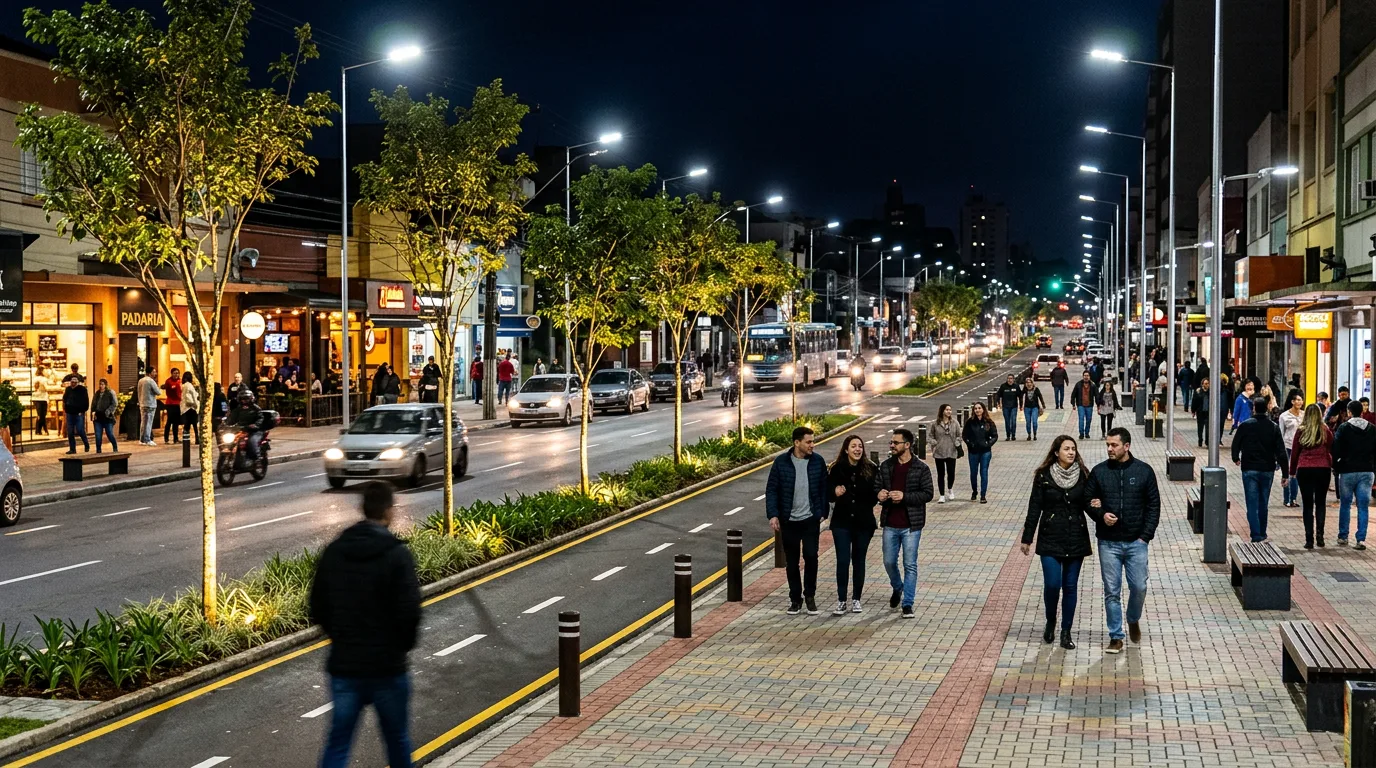
The PPP is the instrument that fits when the service runs a deficit or when there is no tariff that can be charged to the end user. Public lighting is the most classic example. A citizen does not pay a tariff for a streetlight. What pays for it, within the municipal budget, is the Public Lighting Service Levy (COSIP).
In a PPP, the public authority commits to a periodic counter-payment to the private partner, who makes the initial investment and operates the service over a long term. The law sets the contract term at no less than 5 and no more than 35 years (article 5, item I), and the contract value at no less than R$ 10 million (article 2 § 4, item I, as worded by Law 13.529 of 2017).
In a medium-sized city, this is almost always designed as an administrative concession.
BH, Aracaju, Feira de Santana, Franco da Rocha, Hospital do Subúrbio
The Brazilian cases are auditable in detail.
Belo Horizonte signed, on July 13, 2016, the administrative contract of its public lighting PPP with the concessionaire BHIP, BH Iluminação Pública S.A. Estimated value of R$ 991,782,559.72, 20-year term, with a network of about 182,000 light points. It is the Brazilian benchmark for a public lighting PPP in a state capital.
Aracaju, Feira de Santana and Franco da Rocha signed on December 9, 2020, in a ceremony at the Ministry of Regional Development, the first three public lighting PPP contracts structured by the Investment Partnership Program (PPI) with support from FEP Caixa. A 13-year term each, auction held on B3 (the Brazilian stock exchange) on August 14, 2020.
Franco da Rocha is the most instructive case for a city of similar size to Petrópolis. About 10,000 modernized light points, estimated investment of R$ 58 million, discount of 38.75% on the maximum counter-payment at auction (winning bid by the Luz de Franco da Rocha consortium, monthly counter-payment of R$ 249,249.98).
Health has a strong precedent. Hospital do Subúrbio, in Salvador, was the first hospital PPP in the country. An administrative concession signed on May 28, 2010 by the State of Bahia with the consortium formed by Promédica and Dalkia. The hospital received the United Nations Public Service Award in 2015 and recognition by the World Bank in 2013. The contract was renewed in 2023, after about one million patient visits during the period.
Social housing has the municipal Housing PPP, in São Paulo, launched by COHAB in 2018 with an original target of about 34,000 housing units in the central perimeter. Lot 1, with 3,683 planned units, is the most advanced. Execution fell short of the plan. A study by the Center for Metropolitan Studies of USP, published in May 2025, records only 401 apartments delivered in seven years of program. It is a valid case of PPP use in housing, with an explicit caveat about the pace of execution.
Five percent of Net Current Revenue
The limits of the PPP are in the law.
Continuing expenditure arising from the set of PPPs contracted by a state, federal district or municipality cannot have exceeded, in the previous year, 5% of Net Current Revenue (NCR) for the fiscal year, nor may annual expenditures of contracts in force during the following 10 years exceed 5% of projected NCR. This is the ceiling under article 28 of Law 11.079, as worded by Law 12.766 of 2012.
The original ceiling was 1%, in 2004. It was raised to 3% by Law 12.024 of 2009 and to the current 5% by Law 12.766 of 2012. Law 13.529 of 2017, frequently confused with the ceiling increase, in fact addressed a different matter: it created FEP Caixa and reduced the minimum PPP contract value from R$ 20 million to R$ 10 million, precisely in order to enable PPPs in medium-sized municipalities.
5% of NCR is a comfortable margin for a municipality with sound fiscal management. Not to be confused with the federal ceiling, which remains at 1% under article 22 of the same law.
The question that matters in Itaipava is not whether a PPP fits. It is which asset is ready for serious modeling.
Where the work actually gets hard
What gets hard, in a medium-sized city, is not the law.
It is the structuring.
Structuring a PPP requires Technical, Economic-Financial, Legal and Environmental Feasibility Studies. It requires public consultation. It requires draft tender documents, contract and Technical Annex. It requires risk-allocation modeling between the parties. It is expensive and takes time.
That is what the Support Fund for the Structuring and Development of Concession and Public-Private Partnership Projects, the FEP Caixa, established by Law 13.529 of 2017, is for. Caixa, as the manager, pays for the studies. If the PPP goes to auction, the winning bidder reimburses the fund at the end of the process. If the project does not reach auction, the cost remains with FEP. The Investment Partnership Program (PPI), in institutional materials, reports a portfolio of more than 70 projects submitted to FEP and a structuring pipeline concentrated on public lighting, urban solid waste and basic sanitation.
PPPs in lighting, sanitation, solid waste, mobility, administrative centers, health facilities and innovation centers. The menu is broad.
The question that matters
The question that matters in Itaipava is not whether a PPP fits.
The question is which public asset is ready for serious modeling.
Lighting is the natural candidate. It has scale. It has measurable savings with LED. It has comparable cases in state capitals, in medium-sized cities and in small cities. It has experienced operators in the market and a structuring path through FEP.
Solid waste is the second. It has environmental complexity, but it also has precedents and regulatory urgency. The National Policy on Solid Waste requires environmentally adequate final disposal, and the universe of municipalities still out of compliance remains large, according to annual sector reports.
Sanitation depends on the regional structure defined by the 2020 Basic Sanitation Legal Framework.
All of this is back-office work, with private and public actors in technical dialogue.
It is the place where the architect-urbanist shifts from a site plan draftsman to a feasibility broker.
Where the project leaves paper and meets the budget that sustains it.
Sources consulted
All URLs accessed on May 16, 2026.
- Law 8.987/1995, regime for concession and permission of public services, consolidated text, Planalto
- Law 11.079/2004, general rules for the tendering and contracting of PPPs, Planalto. Article 2 (modalities), article 5 (clauses and term), article 22 (federal ceiling) and article 28 (NCR ceiling as worded by Law 12.766/2012).
- Law 12.766/2012, amendment of article 28 of Law 11.079, raising the NCR ceiling from 3% to 5%, Planalto
- Law 13.529/2017, creation of FEP Caixa and reduction of the minimum PPP value to R$ 10 million, Planalto
- Contract of the Belo Horizonte Public Lighting PPP, AJ 016/16, City of Belo Horizonte (SUDECAP). Value of R$ 991,782,559.72, 20-year term.
- PBH Ativos, official page of the Belo Horizonte Public Lighting PPP, 182,000 modernized light points
- Agência Brasil, December 9, 2020, signing of the first public lighting PPP contracts structured by the PPI (Aracaju, Feira de Santana and Franco da Rocha)
- Investment Partnership Program (PPI), official Franco da Rocha page, project parameters and auction result
- Agência Brasil, August 14, 2020, auction of the three municipal public lighting PPPs on B3, with discounts of up to 58%; Franco da Rocha with a 38.75% discount
- SEFAZ-BA, official file on the Hospital do Subúrbio PPP, administrative concession modality, contract of May 28, 2010, UN award in 2015 and World Bank recognition in 2013
- Sesab, renewal of the Hospital do Subúrbio PPP contract in 2023
- COHAB-SP, official portal of the São Paulo Municipal Housing PPP, downtown lot 1
- Center for Metropolitan Studies, USP, 2025, balance of deliveries by the Housing PPP after seven years: 401 apartments delivered
- Booklet Get to Know FEP, Investment Partnership Program, February 2025, portfolio and structuring process
- Law 12.305/2010, National Policy on Solid Waste, Planalto
- Law 14.026/2020, Basic Sanitation Legal Framework, Planalto