

The solution that became the problem
Separating living, working, and shopping into distinct zones was the solution of the 20th century that became the problem of the 21st. The logic seemed irrefutable: take housing away from the noise of the factory, push commerce away from the home, organize the city by function the way an industrial plant is organized. Decades later, the balance of that engineering has three recurring names: the bedroom suburb, the street empty after 6 p.m., and total dependence on the car for every everyday task.
This text does not address those who campaign for walkable cities. It addresses those who decide on land, project, and development: the owner studying what to do with a lot, the developer sizing a product, the public manager who signs off on a zoning parameter. For that reader, the discussion about mixed use is not ideological. It is about the safety of the street, the vitality of the surroundings, and the value of the asset over time. Where the street has continuous movement, the façade works all day long, and the property benefits from it.
The route here is historical and has four real, all verifiable, milestones. A court ruling that turned zoning into law. A charter of architects that turned the separation of uses into doctrine. A book that turned the critique of that separation into a global reference. And a recent concept that turned the mixture back into public policy. Together, they trace a pendulum that has already swung back. One caveat is worth stating from the start: this post asserts no figure without a source. No statistic on value appreciation, car use, or population appears here invented.
Euclid v. Ambler (1926): the day zoning became law
Zoning by use was not born from a congress of urban planners. It was born from a land dispute taken to the Supreme Court of the United States. On November 22, 1926, in the case Village of Euclid v. Ambler Realty Co., citation 272 U.S. 365, the Court decided by 6 votes to 3, in a majority opinion written by Justice George Sutherland, that municipal zoning by use was valid.
The origin of the litigation was concrete. The city of Euclid, in Ohio, had adopted on November 13, 1922, a zoning ordinance that divided the territory into zones and limited use, height, and lot size. Ambler Realty Co., owner of about 68 acres in the city, claimed that these restrictions destroyed the land value and violated the due process of the 14th Amendment. It lost.
The Court established that zoning is a legitimate exercise of the State's police power, and can only be struck down when it is arbitrary and bears no substantial relation to public health, safety, morals, or the general welfare. The standard of validity was recorded in the terms below, in the legal library of Cornell University:
The importance of the decision is hard to overstate. It gave a legal basis to zoning by use in practically all of the United States and became an international reference. The very term Euclidean zoning, which describes the model of a city divided into single-use zones, takes its name from the city in this case. The separation now criticized began, in legal terms, with a ruling that deemed it reasonable.
Athens Charter (1933): the four functions that divided the city
If Euclid gave zoning its legal basis, the Athens Charter gave it its architectural doctrine. The document came out of the 4th congress of CIAM, the Congrès International d'Architecture Moderne, held in July 1933. The congress took place aboard the ship S.S. Patris, on the crossing from Marseille to Athens, which explains the name of the document.
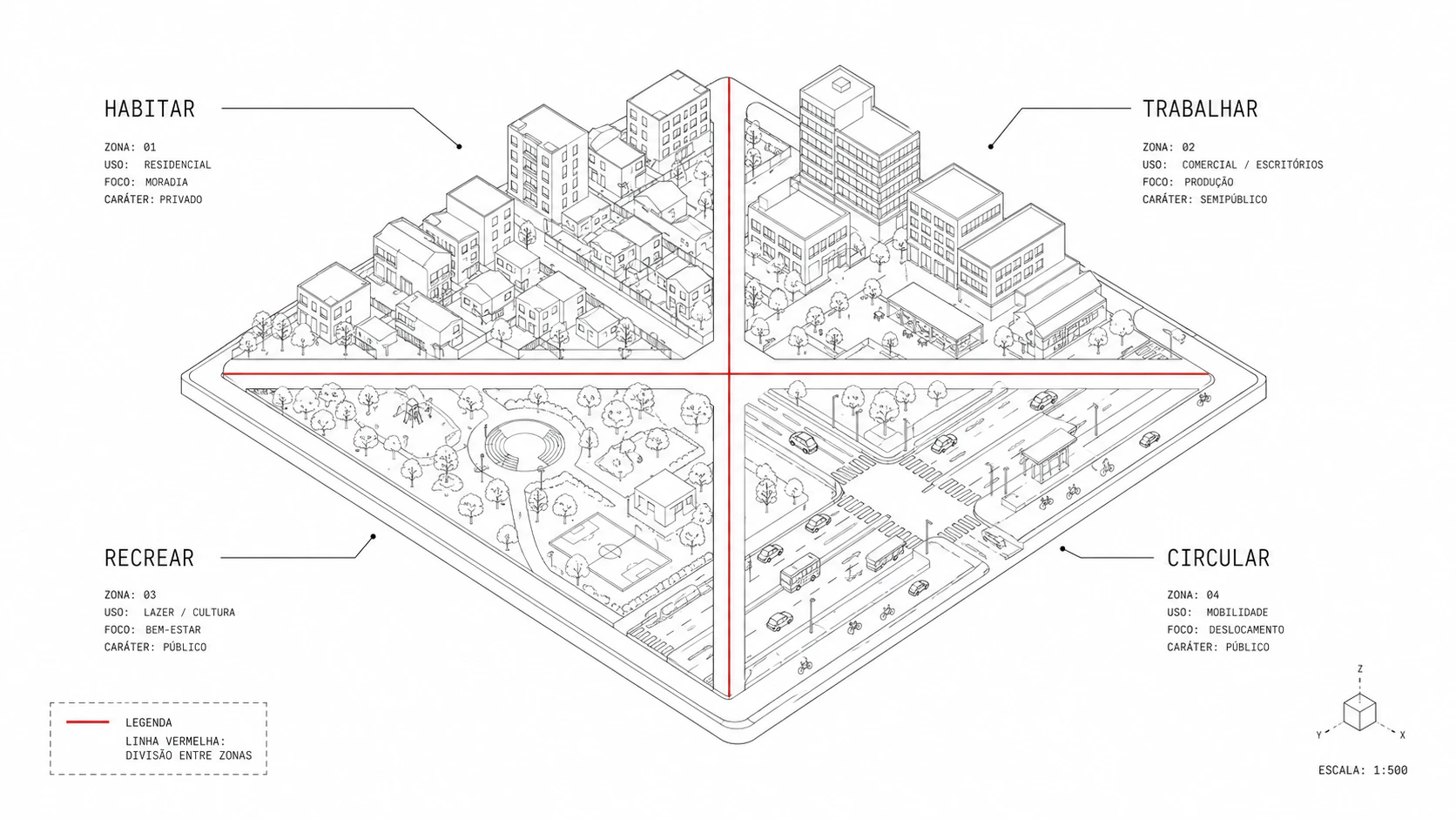
The central thesis of the Charter was to separate urban functions into four well-defined categories: dwelling, working, recreation, which is leisure, and circulation. Each function would have its own place in the territory, isolated from the others. The logic was hygienist and rationalist: keep housing away from noise and industry, create green belts, organize traffic on fast roadway axes, treat the city as an organism whose systems should not mix.
Le Corbusier was a central figure in this process. In 1943 he published the complete and rewritten version of the Athens Charter, to the point that this published version is read far more as an expression of his ideas than as a full CIAM consensus. The caveat is important and the literature maintains it: the Charter that circulated around the world carries the personal mark of Le Corbusier, not the unanimous signature of a congress.
The historical effect was enormous. The separation of functions proposed in Athens became the dominant planning model in the postwar period and is the theoretical root of the single-function district this series criticizes. The coherence of the movement did not last: CIAM split in the 1950s, with the dissidence of the Team X group, which already questioned the rigid scheme of the four functions. The doctrine that separated the city began to be contested from within even before the external critique became famous.
Jane Jacobs (1961): the defense of the mixture
The most influential countercurrent came from outside the modernist school. In 1961, the writer and urban thinker Jane Jacobs published, through the publisher Random House, The Death and Life of Great American Cities. The book directly attacked rationalist modernist planning, naming Le Corbusier and his Radiant City, and Robert Moses and the urban renewal of New York, for separating uses and destroying communities that already worked.
Jacobs did not limit herself to criticism. She defined four conditions that, by her observation, generate urban diversity and vitality:
- Mixed primary uses. The district needs to combine different functions, housing, work, commerce, so that people move through it for different reasons at different times.
- Short blocks. Small blocks multiply the corners and the possible routes, which spreads movement instead of concentrating it.
- Buildings of varied ages and states. The mixture of new and old buildings allows different uses and incomes to coexist on the same street.
- High density of people. Enough concentration of residents and users to sustain commerce, service, and public life throughout the day.
The most cited concept in the book, and the most useful for anyone thinking about property value, is that of eyes on the street: the natural surveillance that comes from the continuous movement of people, and that only exists when there are uses mixed throughout the day. A street with housing, a bakery, an office, and a bar is never deserted at any moment, and the constant presence of people is, in itself, a factor of safety.
Safety and street life are born from the mixture, not from isolation.
It is the classic countercurrent to the Athens model: where the Charter wanted to separate in order to protect, Jacobs argued that separation is precisely what empties and weakens the city.
15-minute city: the mixture becomes public policy
The defense of the mixture left the books and returned to city halls with an operational name. The concept of the 15-minute city, in French ville du quart d'heure, was formulated in 2016 by professor Carlos Moreno, of the University of Paris 1 Panthéon-Sorbonne, affiliated with IAE Paris. The formulation is direct: the resident should be able to reach their daily needs within 15 minutes on foot or by bicycle from home.
These needs cover what the Athens Charter had distributed across separate zones: living, working, supplying, caring for health, learning, and having leisure. The difference is that, instead of pushing them apart from one another, the 15-minute city wants them close, overlapping, within reach of the pedestrian. It is, in practice, mixed use reorganized as an explicit planning objective.
The concept gained political scale in Paris. Mayor Anne Hidalgo adopted the 15-minute city as one of the pillars of her reelection campaign in 2020, with Carlos Moreno in the role of adviser. The following year, the concept received the Obel Award 2021, an international architecture prize, which helped spread it beyond France.
The arc closes here. The 15-minute city is the opposite of what the Athens Charter preached in 1933. Where Athens separated functions into zones, the 15-minute city brings them together in districts. The pendulum that zoning pushed toward separation has swung back to the mixture, now as a goal of urban policy.

Why this matters for those who build and decide
The sequence is clear when seen together. Euclid gave the law. Athens gave the doctrine. Jacobs gave the critique. The 15-minute city gave the correction. Four real milestones, in distinct decades, trace a pendulum that has already completed the movement and returned to the mixture. The table below arranges the four side by side.
| Milestone | Year | What it did |
|---|---|---|
| Euclid v. Ambler | 1926 | The U.S. Supreme Court validates zoning by use as police power. Legal origin of Euclidean zoning. |
| Athens Charter | 1933 | CIAM proposes separating the city into four functions: dwelling, working, recreation, and circulation. Doctrine of the single-function district. |
| The Death and Life of Great American Cities | 1961 | Jane Jacobs criticizes the separation of uses and defends diversity and eyes on the street. The classic countercurrent. |
| 15-minute city | 2016 | Carlos Moreno reorganizes mixed use as a goal of urban policy. Adopted by Paris, awarded in 2021. |
For those who decide on construction, the translation is practical. A street with mixed use tends to have more movement, more perceived safety, and an active façade throughout the day, exactly the factors tied to the attractiveness of an address and the liquidity of a property. The editorial limit applies: that urban vitality is tied to mixed use is a thesis widely sustained in urban planning theory, from Jacobs to the derived literature. Figures on value appreciation do not enter here, and will only enter in future posts of this series with a verified source.
That is the starting point of the series. The next texts will deal with how mixed use applies in practice: the active ground floor, the multi-use building, local regulation that encourages the mixture instead of forbidding it. The goal is the opposite of the 20th century's mistake. Not to separate everything again, but to understand the engineering that makes the street alive, safe, and valued.
Sources consulted
All URLs verified on June 15, 2026.
- Village of Euclid v. Ambler Realty Co., 272 U.S. 365 (1926), Justia U.S. Supreme Court Center.
- Village of Euclid v. Ambler Realty (1926), Cornell Legal Information Institute, Wex.
- Village of Euclid v. Ambler Realty Co., Encyclopedia of Cleveland History, Case Western Reserve University.
- U.S. Reports: Euclid v. Ambler, 272 U.S. 365 (1926), Library of Congress, PDF.
- Athens Charter, Wikipedia.
- Athens Charter, Charte d'Athènes, 1933, Modernism in Architecture.
- The Death and Life of Great American Cities, Wikipedia.
- Jane Jacobs, Project for Public Spaces, PPS.
- 15-minute city, Wikipedia.
- Carlos Moreno, urbanist, Wikipedia.
- The Concept of 15-Minute City Wins 2021 Obel Award, ArchDaily.
- Professor Carlos Moreno receives Obel Award 2021 for his 15-Minute City concept, STIRworld.
- Reimagining a 15-Minute City in Paris, World Resources Institute.
Updated on June 15, 2026. Declared pending: the claim that mixed use raises real estate value is presented here as a theoretical thesis widely sustained, from Jane Jacobs to the derived literature, and not as a quantified figure. Specific figures on value appreciation, car use, or population will only enter future posts of this series upon a verifiable numerical source.