What the EIV is, and why it barely exists
The prior neighbourhood impact study is the instrument through which a municipality makes a development's permit conditional on . It has been in the Statute of the City since 2001, in three short articles. The first of them carries the condition that defines everything else, and it is a condition that .
The sentence begins with . It is not the Statute that says which developments need an EIV: it is the law of each municipality. Without that law, the instrument exists on federal paper and . That is why the EIV is, at the same time, one of the instruments most cited in master plans and .
The available data confirms the diagnosis. In the 2015 Survey of Basic Municipal Information, IBGE found that , against 26.8% in 2013. The institute itself recorded that, in that edition, EIV legislation was in the set surveyed, alongside legislation on consortium urban operations. Fourteen years after the Statute came into force, two out of every three municipalities still had not regulated the instrument.
It is worth reading art. 36 slowly, because it is broader than the common reading suggests. The requirement can reach developments and activities that are , which includes works by the city hall itself. And it is not limited to building: the text refers to permits or authorisations for . An already built property that starts housing a new activity may depend on an EIV to obtain its operating authorisation, without a single wall being raised.
Where the rule comes from: the guideline, the instrument and the master plan
The EIV is not born in isolation in art. 36. It is the technical answer to a of urban policy, listed among the objectives the Statute set out in its art. 2.
The guideline states three legal interests the law wants to protect: the , and the . Note that it refers to a hearing of the municipal government . The EIV is the document that gives substance to that hearing, because without prior measurement the consultation becomes a formality with no content.
In art. 4, which lists the entire toolbox of urban policy, the EIV appears in , and that choice of arrangement says a great deal.
The tax instruments are in item IV, the legal and political ones in item V, and the . The legislator separated them from everything else and placed them side by side, on the same line, with no hierarchy between them. It is the first clue that these are , a point art. 38 will make explicit further on.
The third element is still missing. Like every instrument in the Statute, the EIV only gains traction inside municipal planning, and the Statute sets out when that planning is mandatory.
Read together, the chain closes. The Constitution, in art. 182, hands urban development policy to the municipality. The Statute regulates it and offers the instrument. The master plan defines the territory and the model of city. And the turns all of that into a requirement that can be enforced in the permitting process.
The seven minimum questions of art. 37
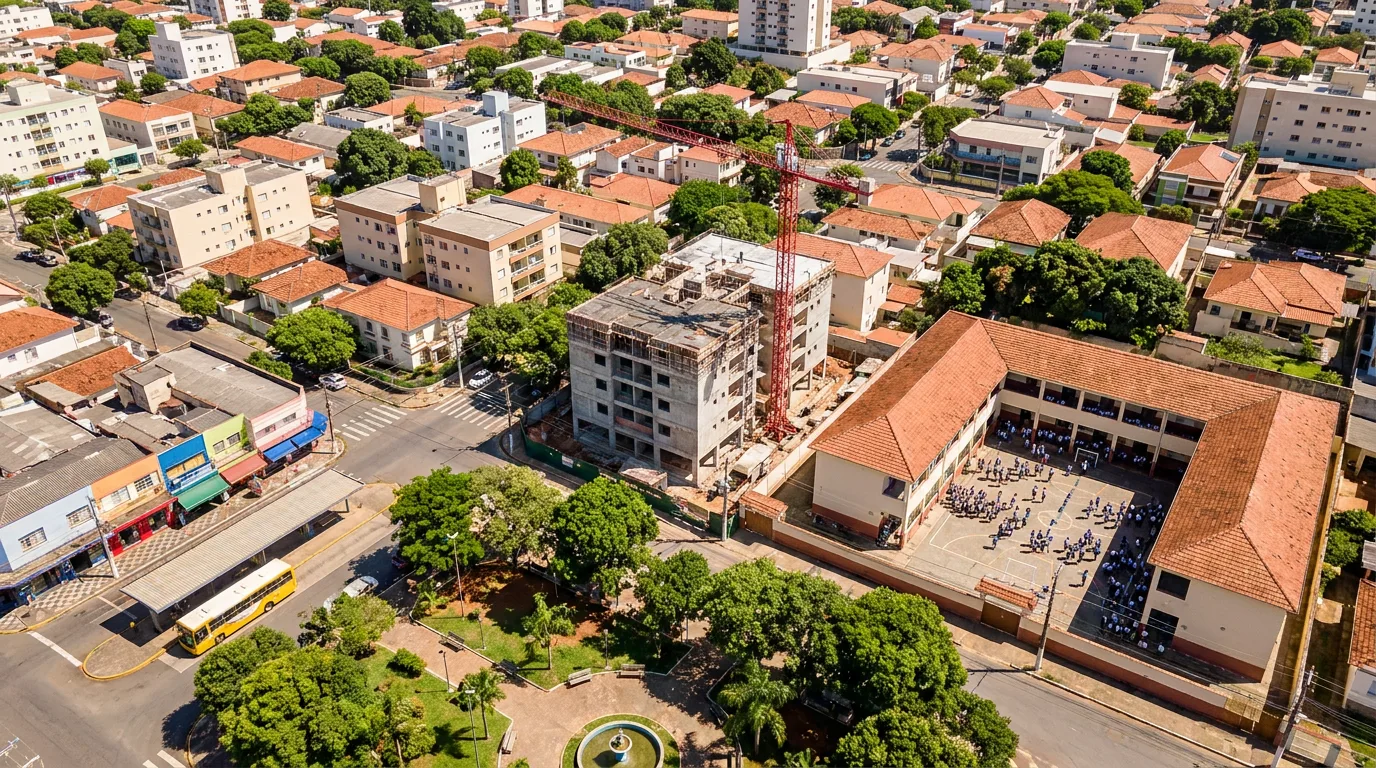
Art. 37 is the heart of the instrument. It defines and, above all, establishes that the look must be : positive and negative effects, not only the harm.
Two expressions in the opening paragraph deserve technical precision. The first is : the scope of the study is not the plot, it is the surroundings, and defining that perimeter is one of the main decisions of the municipal law. The second is : the seven questions are . Municipal law may add others, and well written municipal laws usually do.
| Question in art. 37 | What the study measures in practice | The question the decision maker must ask |
|---|---|---|
| I · Population density | How many more people come to live in or move through the perimeter as a result of the development | Can the existing water, sewage and drainage networks absorb that increase? |
| II · Urban and community facilities | Additional pressure on schools, nurseries, health units, squares and other facilities in the surroundings | Is there capacity in place, or does the development shift the queue to the public sector? |
| III · Land use and occupation | Compatibility between the proposed activity and the pattern of use already consolidated in the neighbourhood | Does the proposed use coexist with its surroundings, or does it tend to push them out? |
| IV · Property appreciation | Effect of the development on land and property prices within the perimeter analysed | Who captures that appreciation, and who is displaced by it? |
| V · Urban mobility, traffic generation and demand for public transport | Trips generated, load on the road system and additional demand on public transport | Can the system take the increase, and is there an alternative to the car for getting there? |
| VI · Ventilation and daylight | Shadow cast over neighbouring properties and obstruction of air circulation | How many hours of sunlight and how much ventilation do the neighbours lose? |
| VII · Urban landscape and natural and cultural heritage | Impact on established views, listed heritage, vegetation and natural features of the surroundings | What of the existing landscape stops being seen, and what is lost irreversibly? |
Read as a whole, the design becomes visible. Items I, II and V deal with . Items III and IV deal with . Items VI and VII deal with . Together, the seven questions cover the three legal interests announced in the guideline of art. 2, item XIII: .
The EIV does not measure the . It measures what the building does to the .
2024: urban mobility enters item V
Art. 37 was recently amended, and the change is small in text and large in reach. Until 2024, item V required the analysis of only. Law 14.849, of 2 May 2024, published in the Official Gazette on 3 May 2024, gave the provision new wording.
The difference between the two versions is not rhetorical. measures vehicles: how many more cars the development puts on the road. is a broader concept, covering the movement of people by every mode, including on foot and by bicycle. By changing the scope, the law widened what the study has to see:
For the municipality, the consequence is practical and immediate. Every municipal EIV law written before May 2024 very probably reproduces the old wording of item V. It , because the federal floor applies in any case, but it does become . It is a low cost, high return adjustment at the next legislative review.
EIV is not EIA, and the law says so in as many words
It is the most common confusion around the instrument, and the law anticipated it with a dedicated article, a single sentence long.
The two studies have . The EIA comes from art. 225 of the Constitution, which deals with the right to an ecologically balanced environment. The EIV comes from art. 182, which deals with urban development policy carried out by the municipality.
Set side by side, the operational difference becomes visible. A development may need both, only one, or neither, and .
| Axis | EIA, prior environmental impact study | EIV, prior neighbourhood impact study |
|---|---|---|
| Constitutional foundation | Art. 225, § 1, item IV, environment | Art. 182, municipal urban policy |
| Rule that sets the requirement | Environmental legislation, as provided by law | Municipal law, under art. 36 of the Statute |
| Trigger | Works or activity potentially causing significant environmental degradation | Development or activity listed by municipal law, in an urban area |
| Object of the analysis | Environmental degradation | Positive and negative effects on the quality of life of the population living in the area and its surroundings |
| Minimum content | Defined by the applicable environmental legislation | The seven questions of art. 37, at a minimum |
| Publicity | Required by the constitutional text itself | Required by the sole paragraph of art. 37 |
| Relationship between the two | Not waived by the existence of an EIV | Does not replace the EIA, under art. 38 |
The practical consequence of art. 38 is a single one, and it is worth saying it plainly: , and obtaining an environmental permit does not waive the EIV where municipal law requires it.
The sole paragraph that turns the study into a public document
Art. 37 ends with a short paragraph that, in practice, is what gives the instrument its .
The wording is deliberately broad on two points. It refers to , in the plural, and not merely to a summary report. And it opens consultation to , without requiring proof of legal interest, without restricting it to neighbours or to parties in the proceedings.
For the public manager, this is the most underrated face of the EIV. A study open to consultation changes the nature of the discussion around a contentious development: the hearing provided for in the guideline of art. 2, item XIII, stops being a clash of perceptions and comes to rest on . When the study is not public, the municipality's decision is exposed to suspicion even when it is technically correct.
The silence of the federal text and what the decision maker needs to watch
A word of caution is needed here, because a great deal of imprecise assertion circulates on this point. The federal text defines , the study is made and it must be shown. It does not regulate what the municipality does with the result.
That does not mean requiring mitigation is improper. It means that , supported by the competence in art. 182 of the Constitution and the guidelines in art. 2 of the Statute, and not a direct imposition of arts. 36 to 38. The distinction is decisive when the requirement is challenged:
- Where the risk lies for the municipality.
- Where the risk lies for the developer.
- What to check in any municipality, in this order.
- What the instrument actually resolves.instrument of transparency with consequences.
The argument closes where it began. The EIV is the instrument that translates a simple question into procedure: Federal law set the seven minimum questions, required both positive and negative effects to be examined, required everything to be made public, and said in as many words that this does not replace the environmental study. Everything else, including the decision whether or not to require it, remains where the Constitution placed it:
Sources consulted
All URLs verified on 27 July 2026.
- Law 10.257 of 2001, Statute of the City, official text, Planalto. Arts. 2 item XIII, 4 item VI, 36, 37 and 38, and art. 41.
- Law 14.849, of 2 May 2024, official text, Planalto. New wording of item V of art. 37 of the Statute of the City.
- Federal Constitution of 1988, official text, Planalto. Arts. 182 and 225, § 1, item IV.
- Profile of Brazilian Municipalities 2015, IBGE, PDF. Chart 4, percentage of municipalities with planning instruments, Brazil, 2013 and 2015.
- The Statute of the City in the Arsenic law library, full text with amendment history.
Updated on 27 July 2026. Declared caveats: the percentage of municipalities with EIV legislation cited in this analysis is from the 2015 edition of the Munic survey, which is the most recent one we were able to verify directly for this specific instrument; later editions of the survey may carry an updated figure, and the text will be revised once there is consolidated, verifiable data. This article describes the federal regime of the instrument and does not replace consulting the legislation of the municipality where the development is located.